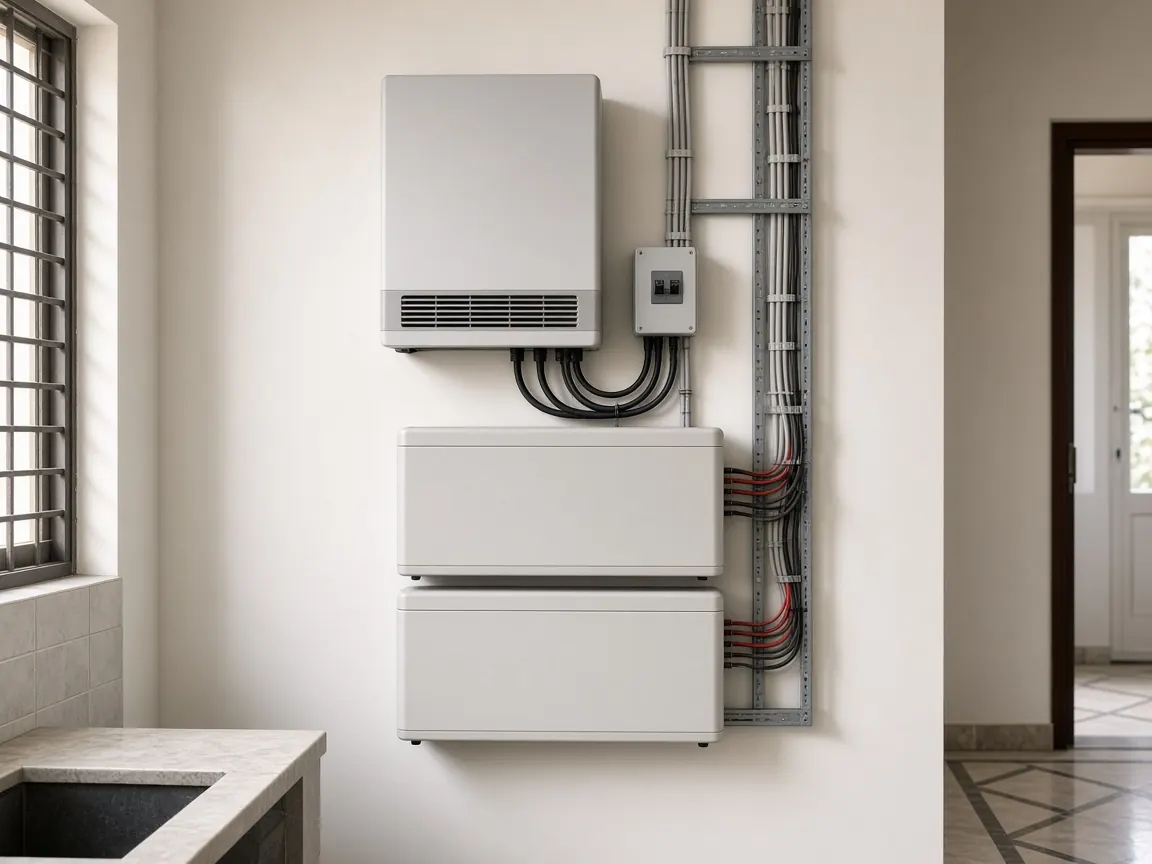
If you search for a 5kW solar system price in Pakistan, you will see numbers from Rs 4 lakh to Rs 13 lakh. Both ends can be honest; they simply describe different systems. This guide breaks the price into parts, using the market rates we track (panels at about Rs 40.0 per watt, median, 28 Nov 2026), so you can see what each quote is really selling and decide between a 5 kW and a 10 kW system.
5 kW and 10 kW price at a glance
| System | Panels | On-grid (estimate) | Hybrid + battery | Typical bill it suits |
|---|---|---|---|---|
| 5 kW | 9 x 585 W | Rs 440,000 3.96 lakh – 4.84 lakh | Rs 660,000 5.1 kWh battery | 400–700 units/month |
| 10 kW | 18 x 585 W | Rs 815,000 7.34 lakh – 8.97 lakh | Rs 1,410,000 10.2 kWh battery | 900–1,300 units/month |
Source: Mastoor Energy - solar system price guide (auto-updated), 11 Nov 2026. Installed, Tier-1 N-type panels, ±10%. Turnkey packages with net-billing filing and service are often higher: e.g. Rs 7.0–8.0 lakh for 5 kW on-grid (Solar Citizen, 2 Nov 2026).
Why quotes for the same 5 kW system differ so much
A "5 kW system" is a label, not a product. Three things move the price more than anything else:
- The inverter. A basic on-grid string inverter and a premium hybrid inverter can differ by more than Rs 1 lakh. Our tracked median for a 4–7 kW inverter is Rs 145,000, but brand and type matter.
- The battery. A standard 51.2 V 100 Ah lithium (LFP) pack, about 5.12 kWh, has a median listed price near Rs 230,000. A 10 kWh bank roughly doubles that. This is the single biggest jump between an on-grid and a hybrid quote.
- What is included. Structure (raised or flush, galvanised or not), DC/AC cable gauge, breakers, surge protection, earthing, net-billing paperwork and the bidirectional meter are often left out of cheap quotes.
Always check the arithmetic: number of panels × panel wattage ÷ 1,000 should be at least 5 for a 5 kW system. Nine 585 W panels give 5.27 kW; nine 450 W panels give only 4.05 kW.

Cost breakdown of a 5 kW on-grid system
Here is how the money splits on a typical 5 kW on-grid system at this week's tracked rates. Use it to compare quotes line by line.
| Item | Assumption | Approx. cost |
|---|---|---|
| Panels | 9 × 585 W N-type at Rs 40.0/W | Rs 210,600 |
| Inverter | 5–6 kW, median of listings | Rs 145,000 |
| Mounting structure | Galvanised, raised | Rs 40,000 – 80,000 |
| Cabling, breakers, SPD, earthing | DC and AC side | Rs 30,000 – 55,000 |
| Installation & transport | Labour and commissioning | Rs 35,000 – 60,000 |
| Net-billing filing & meter | Optional; depends on DISCO | Rs 30,000 – 50,000 |
Panel and inverter lines use our tracked medians (panel prices, inverter prices). Other lines are ranges published by installers in November 2026 and vary by city and roof.
How many units will it produce?
A useful rule for Pakistan is about 4 units (kWh) per installed kW per day as a yearly average. That gives roughly:
Expect 20–30% more in May and June and noticeably less in December and January. Shade from a water tank or a neighbour's wall can cut output far more than people expect, so ask the installer to check the roof at 10 am and 3 pm.
Savings and payback under net billing
Since February 2026, new solar users are on net billing. Units you use at home while the sun shines save you the full grid price, roughly Rs 45–50 per unit for an unprotected household after taxes and adjustments. Units you export are credited at only about Rs 8.13. So the value of a system depends on how much of its output you use yourself.
| Scenario (5 kW, ~600 units/month) | Approx. monthly value | Rough payback on 4.40 lakh |
|---|---|---|
| 70% used at home, 30% exported | Rs 21,203 | 1.7 years |
| 40% used at home, 60% exported | Rs 14,207 | 2.6 years |
Our arithmetic: self-used units valued at Rs 47 (unprotected 201–300 slab, all-in, Nov 2026 bills as reported by theinvestpakistan.com), exported units at the net-billing rate above. Real savings depend on your slab, fixed charges and taxes. A Rs 7–8 lakh turnkey system takes proportionally longer.
The practical lesson: run the washing machine, iron, water pump and AC during daylight. That moves units from "exported at Rs 8.13" to "saved at about Rs 47".
5 kW or 10 kW: which should you buy?
Choose 5 kW if…
- Your summer bill is 400–700 units.
- You run one inverter AC in the day.
- Your usable roof fits about 9–10 panels (roughly 25–30 m²).
Choose 10 kW if…
- Your summer bill is 900+ units, or you run two or more ACs.
- You plan to charge an electric car at home in the daytime.
- You have roof space for about 18 panels (50–60 m²).
If you are between the two, a 6 or 8 kW system is common. Try your own numbers in the solar cost calculator.
On-grid or hybrid with battery?
On-grid systems are cheapest but switch off during load-shedding for safety. A hybrid inverter with a lithium battery keeps lights, fans, internet and the fridge running at night and during outages. With an export rate of only about Rs 8.13, storing your own daytime surplus in a battery is more attractive than it was under the old net-metering rate of Rs 25.32, but a battery still adds Rs 2–5 lakh. A good middle path is a battery-ready hybrid inverter now and a battery later.
Checklist before you sign
- A written quote listing panel brand, model and wattage, inverter model, battery capacity (kWh), structure type and cable sizes.
- Panel serial numbers that can be verified with the manufacturer, and an invoice that names them.
- Earthing for both the panels/structure and the inverter, plus DC and AC surge protection.
- Who handles the net-billing application, and what it costs.
- Workmanship warranty in writing, and who to call for service.
Read our full solar buying guide and which panels to choose.
Frequently asked questions
What is the price of a 5 kW solar system in Pakistan in November 2026?
How many units does a 5 kW solar system produce per day?
What can a 5 kW solar system run?
Is 10 kW better than 5 kW for a home?
How long is the payback of a 5 kW solar system in Pakistan?
Do I need net metering for a 5 kW system?

Published 29 November 2026 · Last updated 29 November 2026. We cite the source and date for every price or statistic and correct errors quickly. Read how we research or report a mistake to [email protected].