1. Size your system
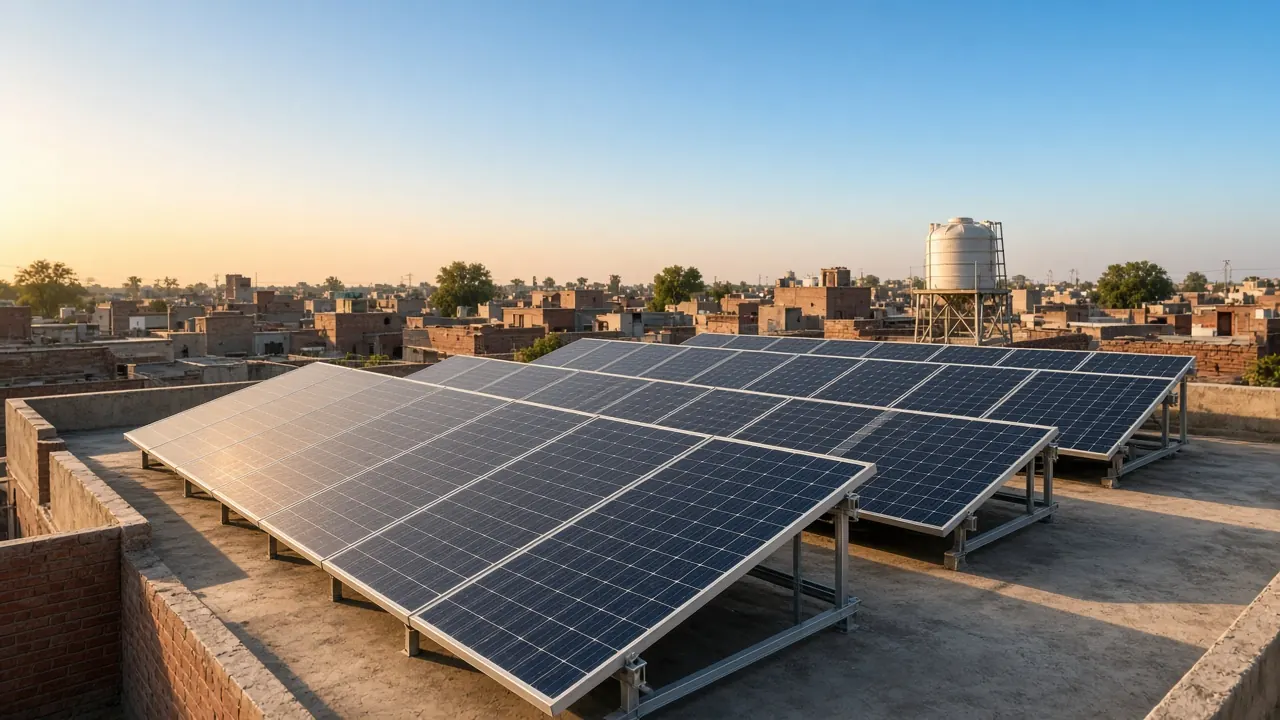
Find your monthly units on a recent bill and divide by about 127 to get kW (Mastoor Energy’s Karachi figure; other sources use 120–135). Decide how many hours of backup you need, and check roof space (about 36 sq ft per panel). Under net billing it usually makes sense to size to your own daytime use.

2. Choose panels
- N-type bifacial panels from established brands (Longi, Jinko, Canadian Solar, JA Solar, Trina and others) are now the mainstream listings.
- Higher wattage (600 W+) can cost less per watt, but check physical size and structure compatibility.
- Ask for the exact model, A-grade documentation and warranty terms.
3. Pick the inverter
| Type | Good for | Trade-off |
|---|---|---|
| On-grid | Stable grid, lower bills | No power during an outage |
| Hybrid | Load-shedding, evening use, backup | Costs more; needs batteries |
| Off-grid | No grid connection | Largest battery needs |
4. Batteries
Lithium (LiFePO4) batteries are the common choice; the standard 51.2 V 100 Ah unit is about 5.12 kWh. Each unit adds a large amount to the cost, so choose based on the hours of backup you really need. See battery prices.
5. Structure, cables and installation
The structure, cables, protection and labour are roughly a fifth of an on-grid system’s cost. An elevated walk-under structure costs more than a standard raised one.
6. Compare quotes
- Ask each installer for an itemised quote (brand, model, wattage, quantity).
- Compare Rs per watt for panels with the current rates.
- Confirm warranty, installation timeline and after-sales support in writing.
- Use the calculator as a sense-check.
Maintenance
Clean panels periodically (dust matters in Pakistan), check connections, and monitor production via the inverter app so you notice drops.
Questions to ask every installer
- Which exact panel, inverter and battery models are quoted? Get brand, model number and wattage in writing.
- What are the warranties? Ask for product and performance terms separately, and who honours them locally.
- What is included? Structure, cables, earthing, protection devices, labour, net-meter paperwork and commissioning.
- What is the payment schedule? Avoid paying everything upfront; stage payments against delivery and commissioning.
- Who does after-sales service? Ask for a phone number and a typical response time.
- Can you show a nearby installation? A recent job in your city is the best reference.
Typical warranty terms to compare
| Component | Typical term (varies by brand) | What to check |
|---|---|---|
| Solar panels | Product warranty often 10 to 12 years; performance warranty around 25 to 30 years | Annual degradation rate and who processes claims |
| Inverter | Often 5 to 10 years | Local service centre and spare parts |
| Lithium battery | Often 5 to 10 years or a set number of cycles | Cycle life, depth of discharge and capacity left at the end |
| Structure and workmanship | Often 1 to 5 years | Wind rating, galvanising and who fixes leaks or damage |
These are general industry ranges, not a promise from any brand. Always read the warranty document for the exact model you buy.
Red flags
- A price far below every other quote, or no model numbers.
- Pressure to pay everything today.
- No written warranty or invoice.
- Thin cables, no earthing or no surge protection.
- Unclear paperwork for net metering or net billing.
Sizing example: from units to kW
A household that uses 650 units a month divides by about 127 units per kW per month, which suggests roughly 5.1 kW. That points to a 5 kW system (or 5.5 kW depending on panel sizes). If your goal is backup during load-shedding, add battery capacity for the hours you need. For example, a 1 kW evening load for four hours needs about 4 kWh of usable battery, and a standard 5.12 kWh lithium battery covers that with some margin.
Use our solar calculator for a cost estimate, and read net metering and net billing before deciding how large to go.
FAQs
How big a solar system do I need?
What warranties should I ask for?
How do I spot a bad quote?
How long does a solar system last?
Should I choose a hybrid or on-grid system?

Published 28 November 2026 · Last updated 29 November 2026. We cite the source and date for every price or statistic and correct errors quickly. Read how we research or report a mistake to [email protected].